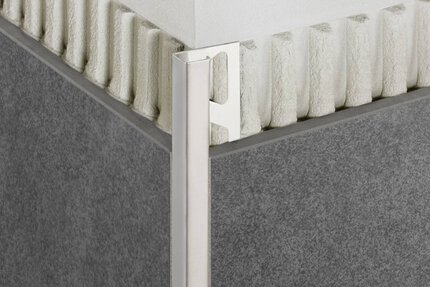
Schluter®-FINEC
Profilé de finition et de protection des rebords à apparence minimaliste

- Prevents tile edges from chipping
- Ideal for creating decorative transitions on walls
- Ideal for use with mosaic tile
- Features a slim and elegant reveal
- Available in stainless steel, as well as various finishes of anodized aluminum



Find recommended accessories here

Estimateur de profilés
Découvrez ce dont vous avez besoin pour protéger les carreaux et faciliter les transitions.
Schluter®-FINEC is a finishing and edge protection profile for the outside corners of tiled surfaces or mosaics.
The profile is available in stainless steel, anodized aluminum, and textured color-coated aluminum. FINEC, in stainless steel, is particularly resistant to wear when used as edge protection. It may also be used as a stair nosing profile.
The Schluter®-FINEC profile requires no special maintenance or care and is resistant to mold and fungi. Clean profiles periodically using neutral cleaning agents.
Stainless steel surfaces exposed to the environment or aggressive substances should be cleaned periodically using a neutral cleaner. Regular cleaning maintains the neat appearance of stainless steel and reduces the risk of corrosion. Avoid the use of strong acids (e.g. hydrochloric or hydrofluoric) and base/alkaline cleaners (e.g. bleach, ammonia, chlorides). Do not use abrasive cleaning agents and tools. Stainless steel surfaces develop a sheen when treated with a chrome-polishing agent.
1. Select the profile according to tile thickness and format.
2. Using a notched trowel, apply thin-set mortar to the area where the profile is to be placed. If the FINEC profile is to be used as edging for an outside wall corner, finish tiling one wall first; then trowel thin-set mortar over the corner area of the second wall.
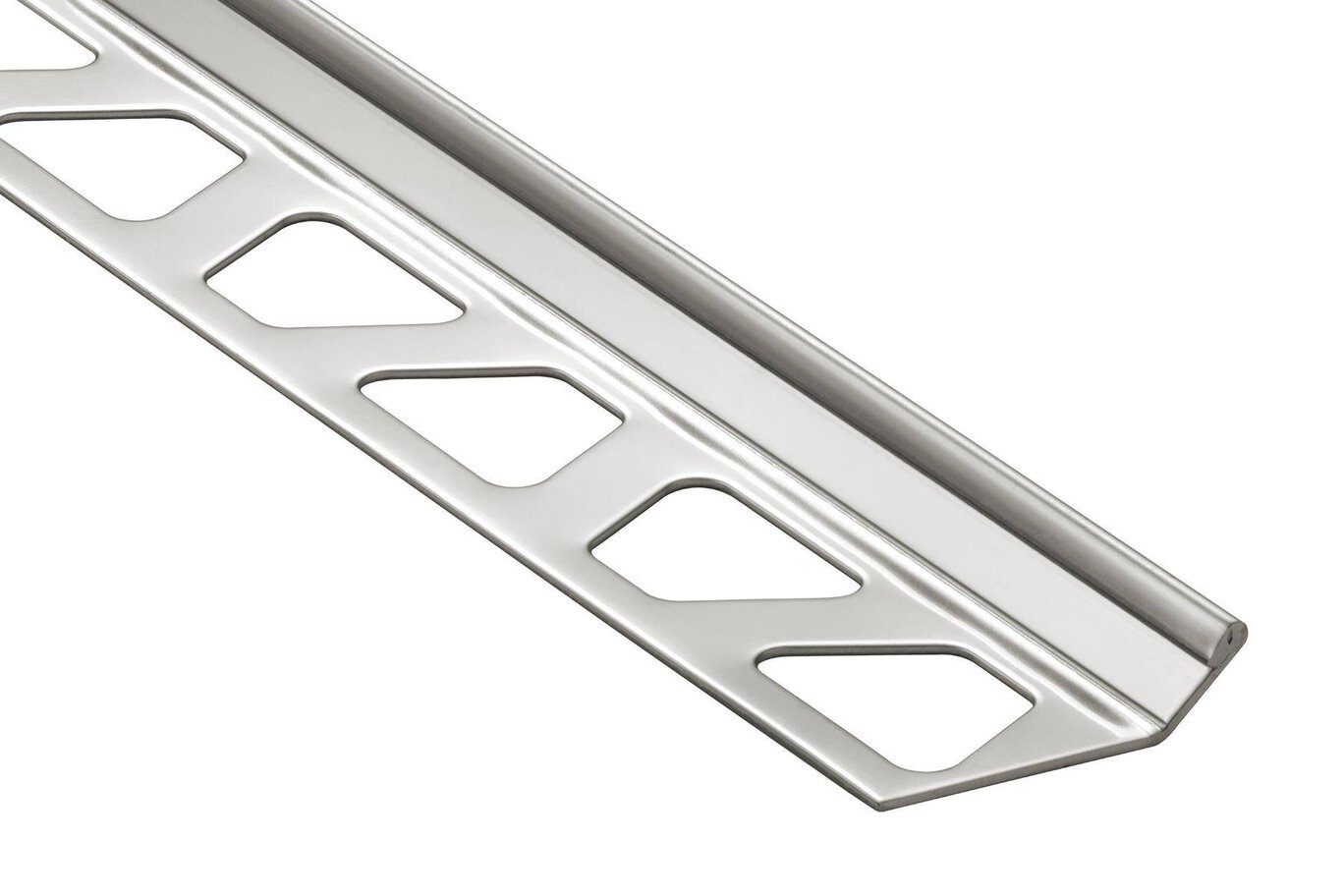
3. Press the perforated anchoring leg of the profile into the mortar and align.
4. Trowel additional thin-set mortar over the perforated anchoring leg to ensure full coverage and support of the tile edges.
5. Bevel tiles adjacent to the profile by 45°. Solidly embed the tiles so that the tiled surface is flush with the top of the profile; the profile should not be higher than the tiled surface, but rather up to approx. 1/32" (1 mm) lower.
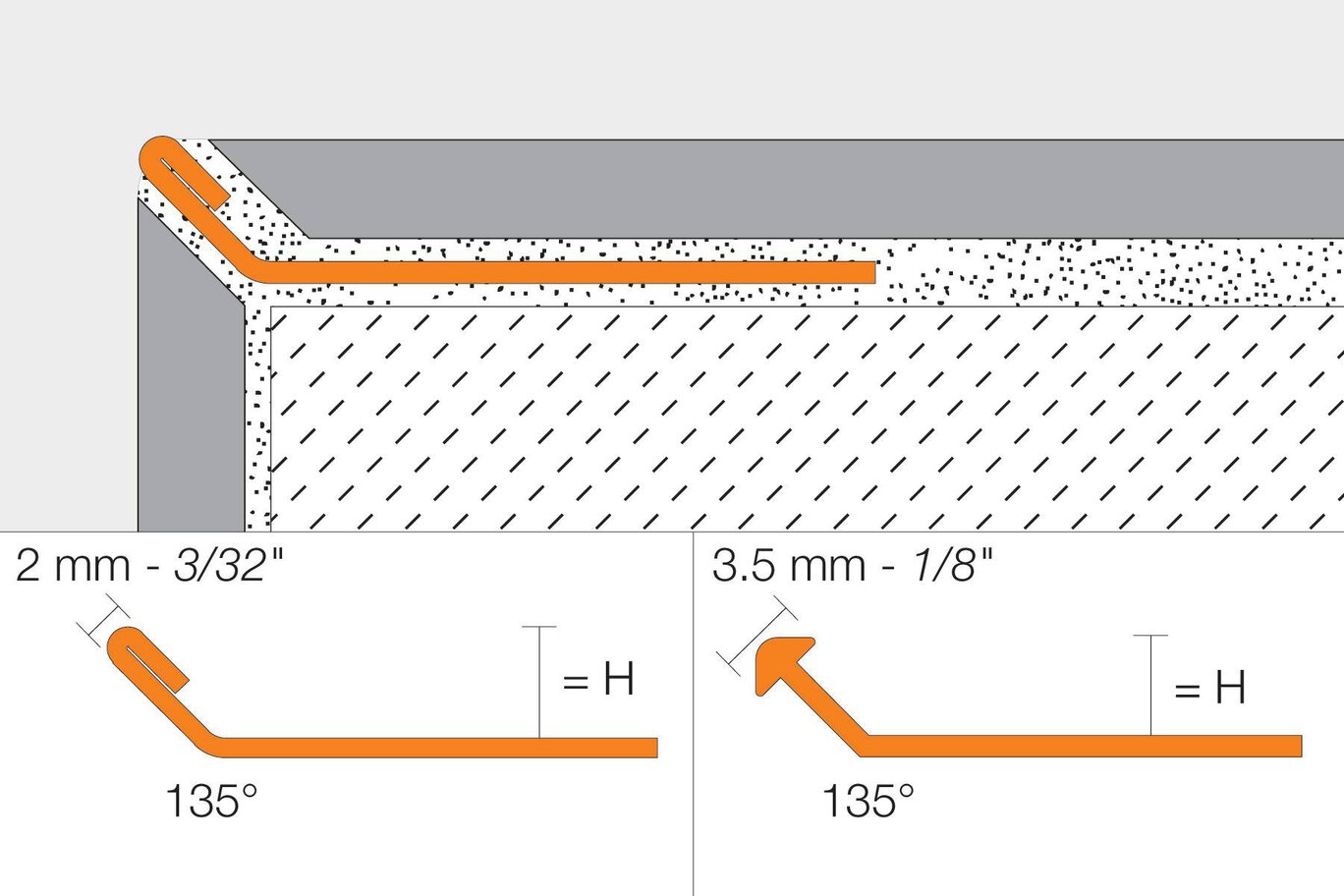
5a. If the FINEC profiles, in aluminum, are used to create a 3 way external corner, into which the two upper profiles were fitted at an angle of 45°, cut the adjoining lower profile to size. The trapezoid-perforated anchor¬ing leg, including the joint spacer, must be cut off straight to the visible area by a minimum dimension x, depending on the profile length; see the AE illustration in the technical data sheet.
5b. If the FINEC profiles, in stainless steel, are used to create a 3 way external corner, into which the two upper profiles were fitted at an angle of 45°, cut the adjoining lower profile to size. In this case, the trapezoid-perforated anchoring leg must be cut off by a minimum dimension x, depending on the profile length, including the visible area has to be chamfered at a 45° angle; see the E illustration in the technical data sheet.
6. Set the tiles to the integrated joint spacer, which ensures a uniform joint of 1/16" to 1/8" (1.5 – 3 mm). With stainless steel, leave a space of approximately 1/16" - 1/8" (1.5 - 3 mm) between the profile and the tile.
7. Remplissez complètement le joint de coulis ou de mortier.
8. Utilisez des matériaux et des outils qui n’égratigneront ni n’endommageront pas les surfaces délicates. Nettoyez immédiatement tout excédent de mortier et de coulis, surtout sur l’aluminium.
Warranties
FAQ
Comment couper les profilés?
Les profilés Schluter™ sont offerts dans une variété de matériaux, c’est pourquoi la technique de coupe varie. Voici les meilleures façons de procéder selon...
Read more